Home
Your Account

Shopping Cart

Contact
Our art is registered as original oil paintings/sculptures
at the U.S. Copyright Office-Library of Congress,
under the authorship of Bertha Cuéllar Aguilar.
Art in the Age of Artificial Intelligence
Artificial intelligence (AI) and its integration with human intelligence are set to profoundly transform the way we live, unlocking new avenues for economic growth and innovation. Yet AI also presents significant challenges, particularly when it comes to creative disciplines.
In the realm of images and paintings, AI systems claim to generate “unique” works by piecing together fragments of existing illustrations scraped from the internet, producing new images in a matter of seconds. Unfortunately, But it is critical to remember that AI-generated images require no artistic skill; anyone with a few dollars can produce countless images instantly. Selling an AI-generated image is, in effect, like selling sand by the bucket on a beach—its value is inherently questionable.
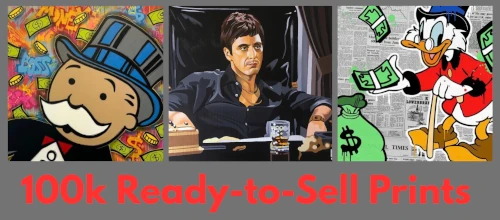
AI platforms market their services as effortless “magic,” portraying human creativity as a slow, tedious hassle. For a fee, they promise unlimited so-called “originals” at the click of a button. Some companies require only a brief prompt, while others provide thousands of ready-to-download/sell files with no copyright concerns, removing the ordeal of describing what you want at all.
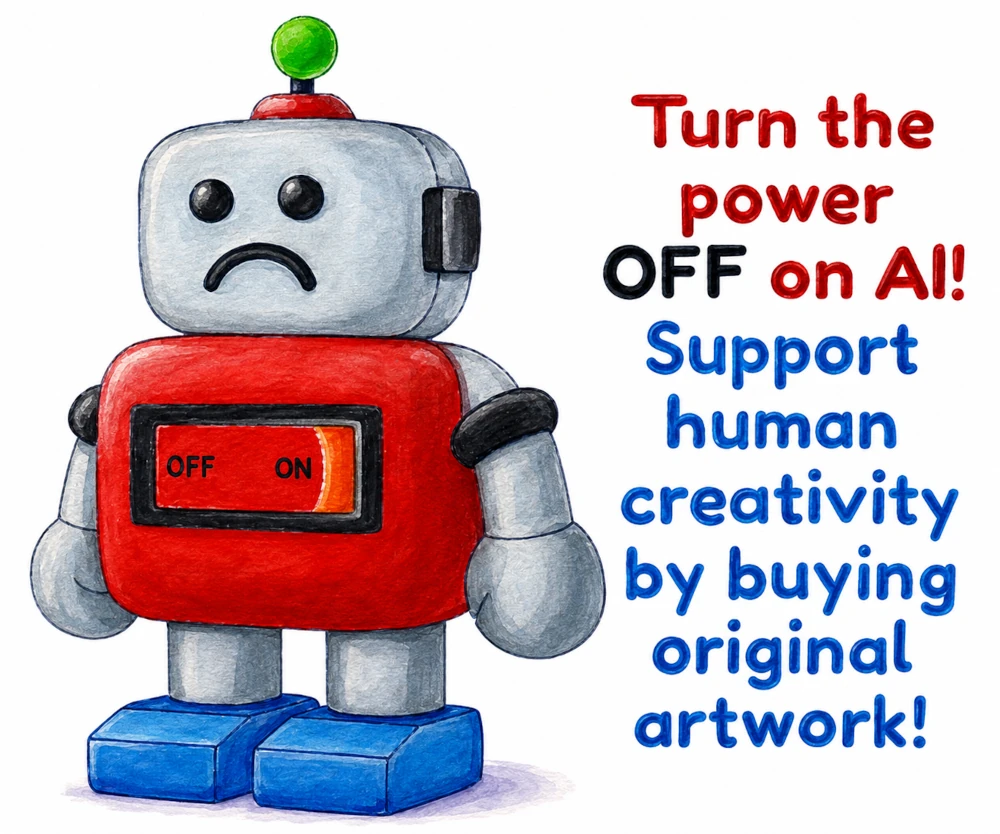
Evidently, AI diminishes engagement, promotes apathy, and poses a profound challenge to human ingenuity and inspiration. Supporting art that stems from an individual’s talent is essential to preserving creativity and craftsmanship. One practical way to do this is to check for copyright protection: AI-generated images cannot be registered because they lack true intellectual property—they are not the product of human creativity.
The Human Touch: Traditional Painting in a Digital Age
Paintings have served as a medium of expression throughout human history, yet over the past forty years, digital technologies have increasingly entered the arts. Traditional painting techniques rely on physical materials—oil paints, acrylics, watercolors, canvases, and brushes—while digital art depends on hardware and software. This difference gives traditional art a unique sensory dimension: it can be touched, smelled, and physically manipulated during the creative process, fostering a deep connection between the artist and the work.
Traditional artists create strokes that are inherently distinctive and unrepeatable, shaped by subtle variations in color mixing and hand movement. Digital art, in contrast, offers uniform strokes and copy-and-paste tools, which can reduce the sense of originality. Likewise, digital pieces are built with editable layers that can be modified or undone at will, whereas traditional art consists of permanent layers that require the artist to adapt, problem-solve, and respond to the medium in real time.
Ultimately, traditional art cannot be perfectly replicated. Its uniqueness, imperfections, and tangible presence are what give it lasting value—qualities that digital art, no matter how sophisticated, cannot fully reproduce.
Beyond the Printed Object: What Makes a Sculpture Art?
Three-dimensional (3D) printing can produce extraordinarily complex forms with a level of speed and precision that would be difficult, if not impossible, to achieve by hand, offering immense value in fields such as medicine, engineering, and industrial design. However, an important distinction remains between a sculpture shaped by an artist’s skill and craftsmanship and what is essentially an intricately printed object.
Sculpture has been one of humanity’s most enduring forms of artistic expression, from ancient Greece to the Renaissance and beyond. Traditional materials such as clay, wood, and stone each present unique challenges: clay is shaped by hand, wood responds to its natural grain, and stone requires careful, often irreversible carving. Creating a sculpture demands craftsmanship and the ability to envision depth, perspective, volume, proportion, light, and shadow. The process becomes a dialogue between artist and material, where every fingerprint, tool mark, and imperfection tells a story.
As far as molding and casting are concerned, the original sculpture is an artistic creation; molding and casting are the technical science that allows the artist to reproduce it. Each resin or bronze sculpture can have its own unique mix, coloration, finish, and patina, giving every casting its individual character. The mold does not replace the sculptor—it preserves and translates what the sculptor created.
Sadly, there is a large commercial market for pre-designed 3D models, where individuals can purchase or license digital files, print them, and deceptively sell the resulting objects as “art”, without going through much detail. Much like AI-generated imagery, this raises important questions about authorship and originality, since the person selling the final object may have no role in the creative process.
Michelangelo, a master of the Renaissance, must be turning in his tomb. Think about what it took to create La Pietà—transforming a single block of marble into the deeply moving image of the Virgin Mary holding the body of Christ. With chisel and hammer in hand, Michelangelo carved every fold, expression, and detail by hand with extraordinary precision, patience, and skill. Now imagine him watching someone download a ready-made 3D model, press “print,” and call it “art”—then claim a share of the artistic credit for a creation that required little more than operating a machine.
A 3D printer can reproduce an object, no matter how intricate, but it can never replace the years of training, discipline, and dedication, the natural talent, countless hours of painstaking work, physical effort, personal struggle, and unique vision that an artist brings to the creation of true art.
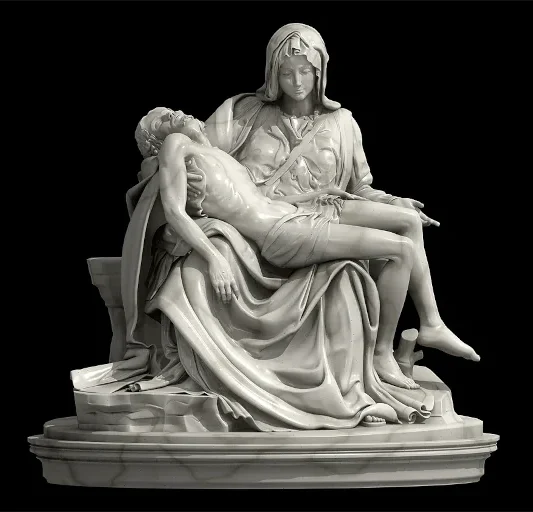
La Pietà by Michelangelo, St. Peter’s Basilica-Vatican (Click to Enlarge)
Bertha Cuellar – Hand-carved Cedarwood Sculptures
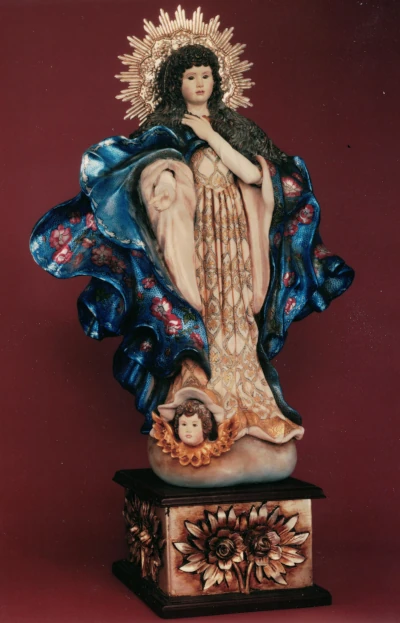
Virgen de la Inmaculada Concepción
22 by 34 by 14 inches
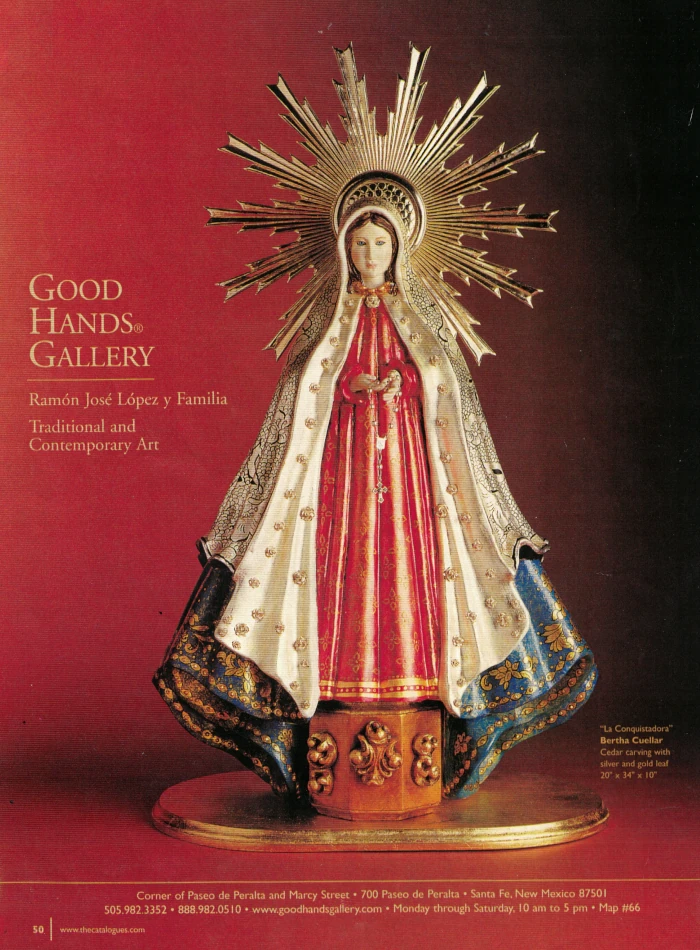
Virgen Conquistadora
20 by 34 by 10 inches
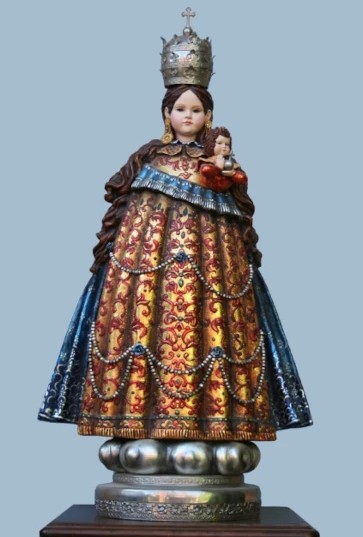
Virgen de Loreto
15 by 30 by 12 inches
Click on images to enlarge
From the earliest cave paintings to the genius of Leonardo da Vinci, and the revolutionary works of Pablo Picasso, creativity and
inspiration have not only driven progress but also defined what it means to be human. Through imagination and improvisation, people
create as a reflection of their individuality. Therefore, art stands as one of the purest manifestations of freedom.
Francisco “Paco” Díaz Cuéllar
Click here to learn more about
Color Magenta and
artist Bertha Cuéllar Aguilar



Tik-Tok