Home
Your Account

Shopping Cart

Contact


Death has been a universal theme of artistic expression across great civilizations throughout the centuries. However, in no culture has this concept been represented quite as it has in Mexico. The work of lithographer and engraver José Guadalupe Posada (1852–1913) established the skull, or calavera, as one of the most significant and recurring motifs in Mexican art—so much so that it has become a globally recognized symbol of Mexico. His imagery is closely associated with Día de Muertos, the Mexican tradition that honours the deceased while celebrating the enduring connection between life and death. Following Posada’s legacy, Mexican artists have continued to portray skulls that appear far from lifeless or grim.
From bullfighters, mariachis, brides, and even mermaids to the world-famous Catrina—depicted in a variety of everyday situations, such as playing music, riding horseback, or even flirting—these figures are far from mournful. Instead, they appear lively, colourful, and often festive. In this context, the celebration of death becomes inseparable from the celebration of life, as the boundary between the two grows increasingly blurred. Death is thus rendered personal and familiar—even playful. La muerte is transformed into something that can be approached with light-heartedness, reflecting a distinctly Mexican sense of creativity and ingenuity. Ultimately, these artistic expressions invite us to laugh at our inevitable end in an ironic and subtly macabre manner.

J. G. Posada
“Within current popular art, death is presented without the majestic grandeur characteristic of pre-Hispanic sculptures or the tragic premonition associated with its Spanish equivalents. Unlike the solemnity found in pre-Hispanic and Spanish traditions, Mexican popular art offers a conception of death nourished by satire, provoking an ironic smile. Here, death is no longer taken seriously; rather, it is given human traits, becoming a friend or compadre with whom one can play jokes.” Death in Mexican Popular Art. Elektra and Tonatiuh Gutiérrez, Artes de México, Number 145, 1971. Page. 75

Juan Soriano

Álvaro de la Cruz

Sergio Bustamante

Rodolfo Nieto
Click on images to enlarge


J. G. Posada outside his engraving workshop
Without a doubt, one of the greatest exponents of Mexican art was the draftsman, lithographer, and engraver José Guadalupe Posada. Born in 1852 in Aguascalientes, Posada learned various engraving techniques from an early age and collaborated with numerous publications throughout his life. It was during his work with the publishing house of Antonio Vanegas Arroyo in Mexico City, however, that Posada produced his most influential works. As has often happened with great talents, he died abandoned and in extreme poverty in 1913, in the notoriously rough neighborhood of Tepito in Mexico City. Unclaimed after his death, Posada was buried in a mass grave; paradoxically, it was his constant engagement with the theme of death that ultimately immortalized him.
To fully understand Posada’s work, it is essential to examine the historical context in which he lived. Born only a few decades after Mexico gained independence from Spain, Posada worked in a society where the majority of the population was illiterate. As a result, illustrators for newspapers and broadsheets assumed the responsibility of communicating events of national importance through imagery rather than written language. In this context, visual language needed to be accessible, direct, and humorous in order to capture public attention. Posada exposed prominent figures in Mexican society—politicians, artists, and public personalities—using death, or more specifically skulls, as central protagonists in his visual narratives.
The majority of Posada’s engravings were produced during the presidency of Porfirio Díaz (1884–1910). This period brought technological advancement and economic growth, but prosperity was unevenly distributed, creating widespread inequality that eventually contributed to the Mexican Revolution (1910–1917). Under the slogan “Order and Progress,” Díaz promoted railways, telephone communication, and the introduction of automobiles; however, these advances primarily benefited a privileged few. Posada’s engravings captured the hardships and injustices experienced by the broader population, using imaginative and satirical depictions of skulls as powerful instruments of social and political criticism.
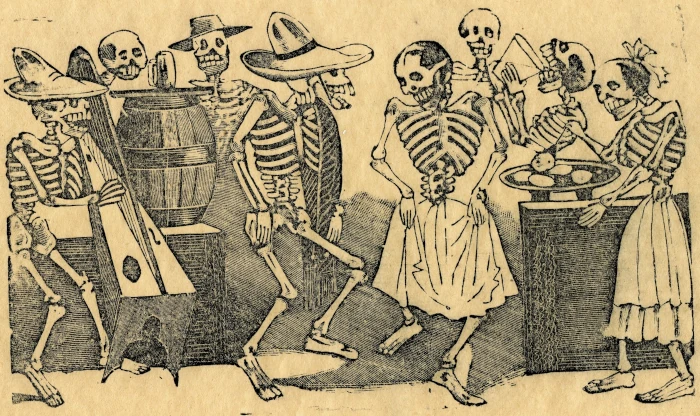
To understand Posada’s criticism of social inequality, one must examine his use of death as a recurring subject and instrument of social satire. His message was clear: regardless of wealth, education, political influence, or social status, everyone shares the same inevitable fate. In death, everyone becomes equal, reduced to bone and stripped of the privileges that once defined their place in society. From this premise, Posada created a wide range of skeletons representing authorities, revolutionaries, peasants, and merchants alike. Through humor and irony, he exposed Mexican society’s contradictions, mocking those who believed their wealth or position put them above others.
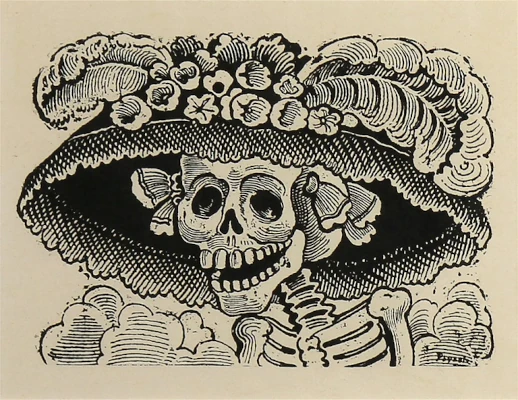
La Catrina Garbancera
Among all of Poasada’s calaveras, one stands out above all others: La Catrina Garbancera. The term catrina derives from the masculine catrín, referring to a person of high social standing, while garbancera comes from garbanzo (chickpea), alluding to Indigenous women who sought to conceal their origins by selling chickpeas instead of the more common corn in an attempt to appear aristocratic.
La Catrina Garbancera is depicted wearing elegant Victorian attire—an ornate hat adorned with feathers or flowers, gloves, and often an umbrella. At the time, clothing served as a clear marker of social hierarchy, and European fashion was adopted by the elite, or by those aspiring to elite status, to distinguish themselves from the working classes. Ultimately, La Catrina Garbancera functions as a caricatural embodiment of social pretension and hypocrisy, exposing the absurdity of denying one’s origins in pursuit of status.
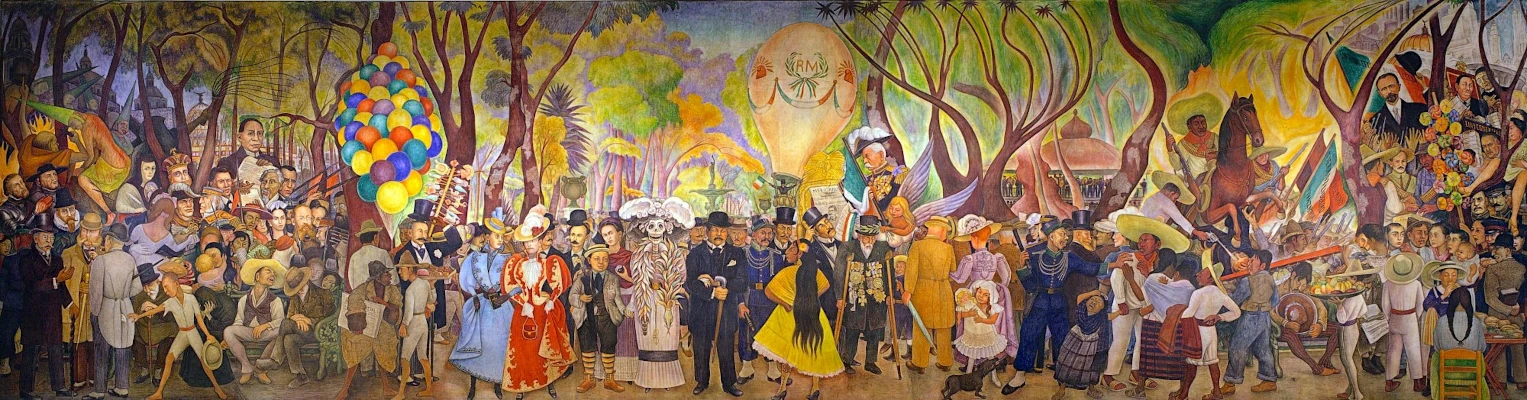
Sueño de una Tarde Dominical en la Alameda Central
Posada’s Rightful Place in Mexican History
José Guadalupe Posada is considered one of the most important graphic artists in the history of Mexico. His skull imagery not only forms an integral part of Mexican visual culture but has also become a global reference for the country itself. Diego Rivera, regarded by many as the greatest Mexican artist, paid Posada what may be considered the most profound tribute imaginable. This homage took the form of a monumental 15-by-50-foot mural that elevated the myth of La Catrina Garbancera.
The mural Sueño de una Tarde Dominical en la Alameda Central (Dream of a Sunday Afternoon in the Alameda Central) presents a panoramic, chronological vision of Mexican history. It features numerous key figures from different eras, including Hernán Cortés, Maximilian of Habsburg, Benito Juárez, and Porfirio Díaz. Despite the historical weight of these personalities, José Guadalupe Posada occupies the central and most honored position in the composition and in Mexican history. He is depicted holding the arm of his most iconic creation, La Catrina, who wears Quetzalcóatl, the Feathered Serpent, as a scarf—subtly linking pre-Hispanic mythology to modern Mexican identity—while holding the hand of a child version of Rivera, standing only inches away from Rivera’s equally renowned wife, Frida Kahlo.
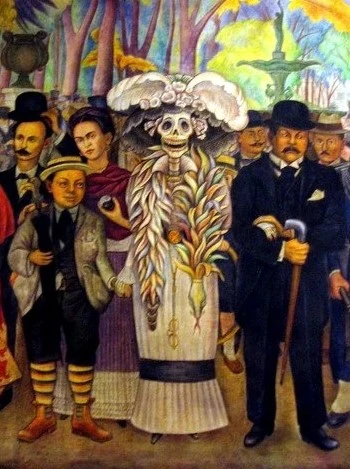
Diego, Frida, La Catrina, and Posada
The Journey to Mictlán: Aztec Views of Death and the Origins of Día de Muertos
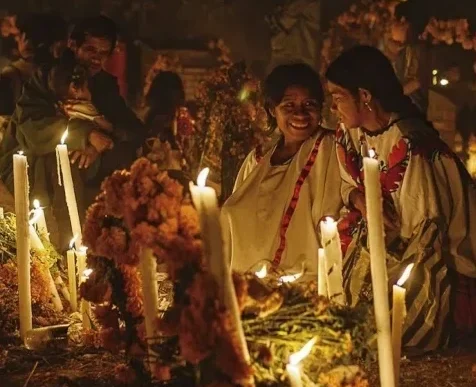
The cult of the dead has been a fundamental aspect of civilizations throughout history. However, no country commemorates death in a manner as deeply rooted, mystical, and joyful as Mexico. While in many other nations death is approached with solemnity, on the first two days of November Mexico celebrates its most emblematic holiday, Día de Muertos, with flowers, costumes, food, drinks, music, and laughter. Día de Muertos is not a day of mourning, but a celebration of life. Mexicans deeply believe that by remembering the deceased with affection and joy, they continue to exist. To fully understand Día de Muertos and the unique relationship Mexicans have with death, however, one must look back to pre-colonial times
The Aztecs, inhabitants of Tenochtitlan—present-day Mexico City—possessed a distinctive way of understanding the world, life, and death. Like many ancient cultures, they embraced a cyclical view of the universe and therefore regarded death as an inherent part of life. Notably, in the Aztec Empire, as in many other early civilizations, rituals and festivities related to death coincided with the beginning of the harvest. For the Aztecs, dying did not signify an end, but rather the possibility of a new beginning.
In sharp contrast to Catholic beliefs, the Aztecs did not conceive of the afterlife in terms of heaven and hell. Instead, they believed that a person’s destiny after death depended largely on the circumstances of their passing. Their worldview included several realms of the afterlife, each associated with different causes of death. For those who died of natural causes, the destination was Mictlán, the underworld ruled by Mictlantecuhtli, the Aztec god of the dead. To reach Mictlán, the soul had to undertake a difficult journey through a series of trials, traditionally described as lasting four years, before reaching its final resting place. On earth, relatives performed rituals and prepared offerings to honor the deceased and support their passage into the afterlife.
Although the Aztecs did not celebrate Día de Muertos as we know it today, ancient Indigenous beliefs and rituals surrounding death and the journey to Mictlán form part of its cultural roots. Over centuries, the modern Mexican tradition emerged from the encounter between Indigenous spiritual practices and Catholicism introduced by the Spanish during the conquest and colonization of Mexico. Catholic missionaries initially sought to replace Indigenous religious customs. Still, they gradually incorporated elements of pre-Hispanic celebrations of the dead into Christian observances, particularly All Saints’ Day (November 1) and All Souls’ Day (November 2), the same days Día de Muertos is celebrated.
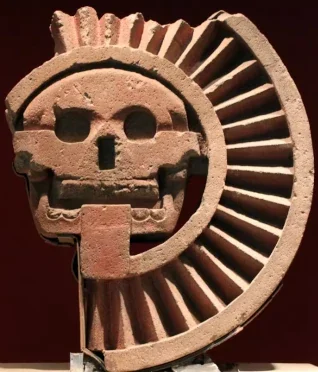
Mictlantecuhtli
This cultural and religious fusion gave rise to a uniquely Mexican tradition, blending Indigenous understandings of death and the afterlife with Catholic prayers, masses, offerings, and commemorations of the departed. Over time, it created a lasting ritual and emotional bond between the living and the dead, expressed through offerings of food, flowers, candles, and other meaningful objects that welcome the deceased, honor their memory, and keep them present in the lives of the living.
It is worth briefly noting that Mictlán was not the only destination for the dead, since obviously not everyone dies of natural causes. Omeyocan, the realm of Huitzilopochtli, welcomed warriors who died in battle and women who died in childbirth, where they enjoyed eternal songs and dances before returning to earth as birds. Chichihualcuauhco was reserved for deceased children, whose souls were destined to return when humanity was reborn. Finally, Tlalocan, the paradise of Tlaloc, the god of rain, received those who died by drowning.
Guiding the Souls: Cempasúchil and the Symbolism of Día de Muertos Altars
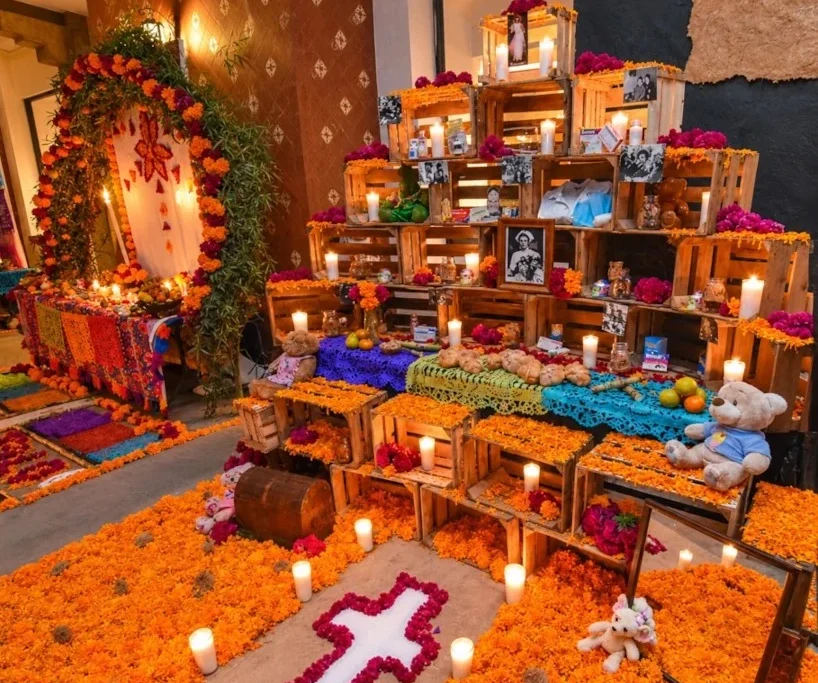
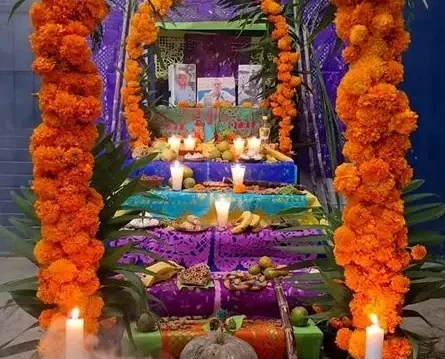
During Día de Muertos, altars are created not only to honor and remember the dead, but also to welcome their souls and guide them on their spiritual journey to Mictlán, the underworld in Mexica mythology. These altars incorporate a wide variety of elements, including papel picado, candles, food, water, sugar skulls, flowers, crucifixes, and rosaries, as well as more personal objects such as handwritten messages, photographs of the deceased, and belongings that once belonged to them. Each element carries a symbolic meaning, helping create a welcoming space where the souls of the departed can return to visit their loved ones. Marigolds, known as cempasúchil, are traditionally used to guide the spirits with their vibrant color and distinctive fragrance, while candles illuminate their path. Symbolically, Día de Muertos altars function as bridges between the worlds of the living and the dead: they evoke the lives, personalities, and memories of those who have passed away while expressing the enduring love and spiritual connection that unite them with the living. Through this tradition, death is not understood simply as an ending, but as part of a continuing cycle of remembrance, return, and renewal.
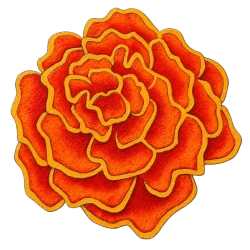
Native to Mexico, the cempasúchil blooms in autumn after the rainy season, and its life cycle coincides with the Día de Muertos celebrations. The word cempasúchil has pre-Hispanic origins, derived from the Nahuatl words cempoal, meaning “twenty,” and xóchitl, meaning “flower,” often interpreted as “the flower of twenty petals.”
The Aztecs believed that its intense orange and yellow petals captured the rays of the sun and that its strong scent could attract even the dead. For this reason, pathways of cempasúchil petals are traditionally laid out as a symbolic road, as their vivid colors and powerful aroma are believed to guide the souls of the deceased back to their altars.
Eternal Love: The Legend of the Hummingbird and the Cempasúchil
Halloween and Día de Muertos: Commercialism vs. Creativity and Remembrance
People often confuse Día de Muertos with Halloween; however, it is essential to distinguish between the two festivities. Halloween originates in Northern Irish traditions that marked the end of the harvest season and the beginning of the Celtic year. In this context, death is frequently portrayed as an encounter with frightening beings such as ghosts, witches, or monsters. By contrast, Día de Muertos is a celebration rooted in pre-Hispanic Mesoamerican traditions and is likewise connected to the agricultural cycle, yet it is not intended to be frightening. In Mexico, the dead are joyfully welcomed with music, dance, and vibrant colors.
The proximity of the dates on which Día de Muertos and Halloween are celebrated often adds to the confusion; however, this overlap is largely the result of Catholic influence rather than shared origins. Día de Muertos takes place on the first and second of November to coincide with the Catholic observances of All Saints’ Day and All Souls’ Day, dates established by Spanish missionaries following evangelization. Halloween, celebrated on October 31, derives from All Hallows’ Eve, the vigil preceding All Saints’ Day. The closeness of these dates reflects independent efforts to align different traditions with the Christian calendar, rather than any common symbolic meaning.
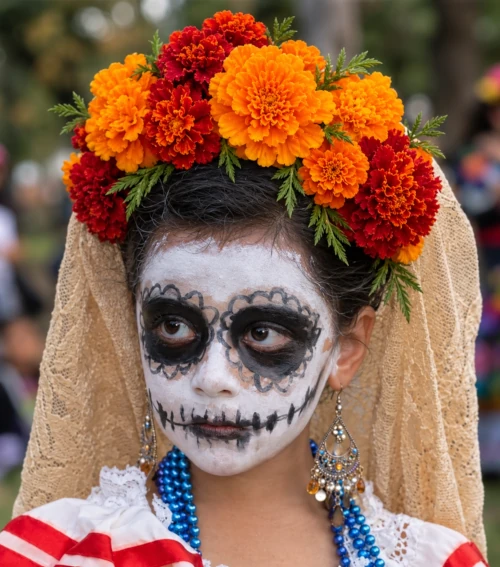
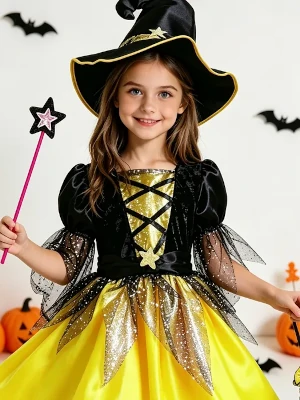
Another important distinction lies in how these traditions are celebrated today. Halloween is often associated with commercialism, seasonal decorations, candy, and disposable merchandise, including inexpensive, ready-made costumes that leave little room for originality and imagination. Día de Muertos, by contrast, emphasizes remembrance, creativity, and love. Families create colorful altars, decorate with cempasúchil flowers, prepare the favorite foods of their departed loved ones, and honor their memory through meaningful traditions rather than material possessions. In short, Halloween often turns death into something to fear, while Día de Muertos teaches us to remember those who have passed with love.
Finally, it is worth noting that the United Nations Educational, Scientific, and Cultural Organization (UNESCO) has recognized Día de Muertos, and not Halloween, as an Intangible Cultural Heritage of Humanity, acknowledging its profound cultural, historical, and spiritual significance. This designation reflects the tradition’s role in preserving ancestral customs, strengthening family bonds, and celebrating cultural identity.
Francisco “Paco” Díaz Cuéllar

It is our mission at Color Magenta, not only to make products
we are proud to sell, but also to deliver a message.
Click on the icons below to learn more about:


Tik-Tok